In today’s competitive digital market, businesses need more than just a website to attract customers. They need a strategy that helps the right people discover their business and take action.
Two of the most popular digital marketing strategies are Search Engine Optimisation (SEO) and paid advertising. Both can bring traffic and generate leads, but they work in very different ways.
So, which one is better for your business?
The answer depends on your goals, budget, industry, competition, and how quickly you want to see results.
What Is SEO?
SEO is the process of improving your website and online presence so that your business can appear higher in organic search results.
For example, if you provide website development services in Dubai, you may want your website to appear when someone searches for terms such as “website development company in Dubai.”
SEO can involve:
- Keyword research
- Website optimisation
- Technical SEO
- Creating useful content
- Local SEO
- Improving website speed
- Building quality backlinks
- Optimising pages for search intent
The biggest advantage of SEO is that it can continue generating organic traffic without paying for every visitor.
What Are Paid Ads?
Paid advertising allows businesses to pay platforms such as Google and social media networks to display advertisements to specific audiences.
With search advertising, your business can potentially appear near the top of search results for selected keywords almost immediately.
Paid campaigns can be used to:
- Generate leads
- Promote products and services
- Drive website traffic
- Increase enquiries
- Promote special offers
- Reach specific customer segments
- Retarget previous website visitors
The major advantage of paid advertising is speed. Once your campaign is approved and running, you can start receiving targeted traffic.
SEO vs Paid Ads: What’s the Difference?
The key difference is how you acquire visibility.
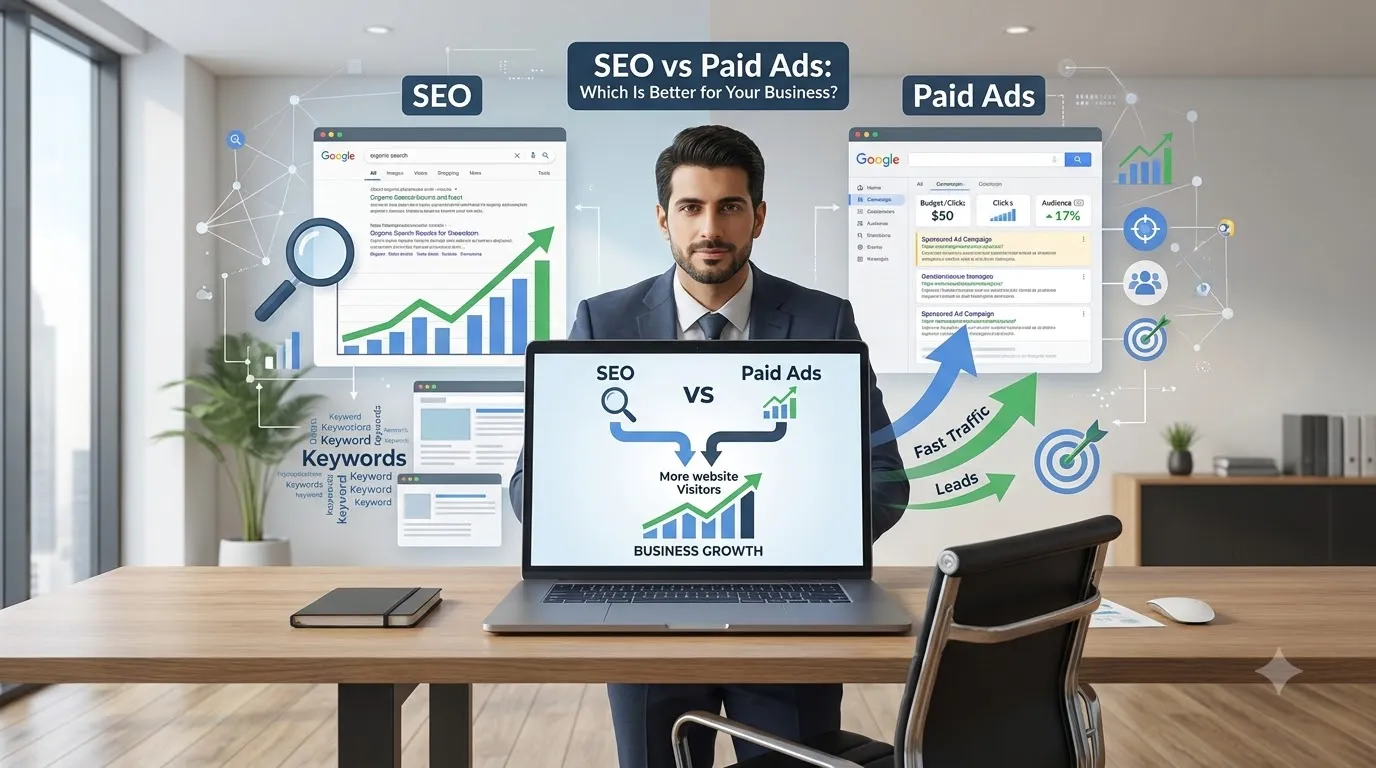
SEO focuses on earning organic visibility, while paid ads focus on purchasing targeted visibility.
|
SEO |
Paid Ads |
|---|---|
|
Organic traffic |
Paid traffic |
|
Takes time to build |
Can generate traffic quickly |
|
Long-term strategy |
Short- to medium-term campaigns |
|
No cost per individual click |
Usually charged per click/impression |
|
Builds long-term visibility |
Provides immediate exposure |
|
Requires ongoing optimisation |
Requires ongoing advertising budget |
When Should You Choose SEO?
SEO can be a strong choice if your business wants sustainable online growth.
It is particularly useful when:
- You want consistent organic traffic
- Customers regularly search for your services online
- You want to build long-term visibility
- You are willing to invest in a longer-term strategy
- You want to reduce dependence on paid traffic over time
However, SEO usually takes time. Depending on your industry, competition, website condition, and target keywords, meaningful results may take several months.
When Should You Choose Paid Ads?
Paid advertising can be useful when you need faster results or want to promote something specific.
It can work well for:
- New product launches
- Special offers
- Time-sensitive campaigns
- Lead-generation campaigns
- E-commerce promotions
- Highly competitive search terms
- Businesses that need immediate website traffic
The important thing to remember is that paid advertising requires an ongoing budget. When you stop the campaign, the paid traffic generally stops as well.
Why Not Use Both?
For many businesses, the best strategy isn’t choosing between SEO and paid ads.
SEO and paid advertising can work together.
Paid ads can help generate immediate traffic and leads while SEO builds long-term organic visibility.
For example, a business launching a new service could run Google Ads to generate immediate enquiries while simultaneously creating SEO-focused landing pages and content around the service.
Over time, the business may begin receiving more organic traffic while continuing to use paid advertising for high-value campaigns.
Consider Your Customer Journey
Before choosing a strategy, think about how your customers find and choose a business.
Some customers may search Google when they are ready to buy. Others may discover a business through social media, advertisements, recommendations, or content.
Understanding your audience can help determine where your marketing budget should go.
Instead of asking “SEO or paid ads?”, ask:
“Where are my potential customers searching, and what will convince them to contact me?”
Don’t Ignore Your Website
Whether visitors come from Google search, an advertisement, social media, or another source, they eventually need a place where they can learn about your business.
A poorly designed website can waste both your SEO investment and your advertising budget.
Your website should have:
- Clear messaging
- Fast loading pages
- Mobile-friendly design
- Strong calls-to-action
- Simple navigation
- Relevant service information
- Trust signals such as reviews and testimonials
- Easy enquiry and contact options
A strong website combined with the right marketing strategy can help turn traffic into actual business opportunities.
Which Strategy Is Better for Your Business?
There is no universal answer.
Choose SEO when your priority is long-term organic growth and sustainable visibility.
Choose paid ads when you need targeted traffic and faster results.
Use both when you want to combine immediate lead generation with long-term online growth.
The right digital marketing strategy should be based on your business objectives, target audience, competition, and available budget—not simply on which channel is more popular.
Final Thoughts
SEO and paid advertising are not competitors. They are two different tools that can support the same business goal: getting your brand in front of the right customers and turning that visibility into growth.
A well-planned digital marketing strategy can combine SEO, paid advertising, content, social media, and a conversion-focused website to create a complete customer acquisition system.
Connect with Nexever for the best solution.